


New Shapes of Meaning is a STEAM education curriculum scroll for teachers and self-guided interdisciplinary learning.
The following iteration was first produced for Nevada Museum of Art & Desert Research Institute’s Science Alive Teacher-training Conference at Nevada Museum of Art in 2016. Followed by Nevada STEM Coalition’s Teacher Training Program, 2016; NMA’s STEAM Conference, 2017; and Clark County School District’s CONFABULATION Teacher Training Conference, 2017.
The latest iteration is currently under development for Eight Arm Farm - a hyper local, clean food production, distribution and STEAM education enterprise based in the Truckee Meadows.
AUDIENCE:
K-12+
TIME:
1-3 hours, variable.
STEAM SUBJECTS:
ART, MATH, LIFE SCIENCE.
The following curriculum scroll contains YouTube Videos & other embedded material subject to copyright and is intended for educational use only. questions regarding redistribution or to inquire about bringing the latest version of new shapes to your organization, staff or students please email its author, Aimee Weintz Allen @ letter2aimee@protonmail.com.
LET’S PLAY!

You’ve been given a white ‘design board’ & 6 square pieces to work with, each a different color.
PLAY with the squares:
Arrange the squares on your design board,
into a rectangle.
Two Constraints:
1) None of the squares may overlap.
2) Neither of the two smallest may be placed along the outside edge (perimeter).
POSSIBLE DESIGNS/CONFIGURATIONS
Does your design look like one of these?
…It should.
Describe what is happening, visually.
Are the squares in any kind of order?
How many rectangles can you locate?


GOLDEN RECTANGLES
Below is a math equation.

The above rectangle (a+b) is a golden rectangle, also known as the Greek letter phi.
It exhibits a special form of self-similarity:
The whole has the same shape as one or more of the parts.
Phi can be represented:
Graphically (squares above).
logically: a+b is to a, as a is to b.
And also as number: the golden ratio is approximately equal to 1.618…


This idea grows.

Let’s PLAY again!
If the dimensions of the smallest squares are 1x1 inch, what are the dimensions of the 4 remaining squares?
____ x ____ in.
____ x ____ in.
____ x ____ in.
____ x ____ in.
If we continue to build out the design, what will be the dimensions of the next largest square?
____ x ____ in.
How did you come to your prediction?
What is happening here?
And why?

Let’s recap:

The two smallest squares are both 1 in .x 1 in.
The 4 remaining squares are:
2 in. x 2 in.
3 in. x 3 in.
5 in. x 5 in.
8 in. x 8 in.
If we continued to build out the design, what would the dimensions of the next largest square be?
13 in. x 13 in.

The WHAT: It’s A SEQUENCE.
In mathematics, a sequence is an enumerated collection of objects. It can be thought of as a list of elements with a particular order.
Is there a numeric sequence or order to these numbers?
See the future - predict again:
Were this design to continue to expand, where would the next square (at 34 in. x 34 in.) be placed in the design?
EYE SPY A SEQUENCE!
The Fibonacci Sequence!
A Fibonacci sequence of numbers is one in which each number is the sum of the two preceding ones, starting from 0 and 1.

0+1=1
1+1=2
2+3=5
3+5=8
5+8=13
8+13=21
…0,1,1,2,3,5,8,13,21,34, 55 and so forth…
THE FIBONACCI SEQUENCE
A BRIEF HISTORY

The Fibonacci Sequence is a sequence of numbers. in which every number is the sum of the two previous.
While It is named after the Italian mathematician and merchant, Leonardo of Pisa, commonly known as Fibonacci, the history of the sequence goes as far back as 200BC.
Indian mathematics as early as 200 BC, in work by Pingala looked for possible patterns in Sanskrit poetry, formed from syllables of two lengths. music was often created applying beats from patterns derived by the sequence.
another 1400 years passed before Fibonacci himself published on the subject, with Liber Abaci, in 1202, which introduced the sequence to Western European mathematics by demonstrating its use in a thought experiment pertaining to reproduction in imaginary rabbits & honey bees.
While the history and cultural references derived from the sequence are fascinating - it is the nature of the sequence itself; the consequence of recursive growth and dimensional spiral that is generated from the ratios that is most Remarkable.
the sequence of numbers and consequential ratio between them produces what is known as a golden spiral - an expanding form, with a spacial relationship that mirrors both behavior and growth patterns found in living systems throughout the cosmos.
“The human mind always makes progress, but it is a progress in spirals.”
Madame de Stael

Nature expresses itself through spiral in countless ways throughout living natural systems - often to such a degree that they mirror or reflect the qualities of the Fibonacci Sequence and/or Golden Ratio/Spirals.
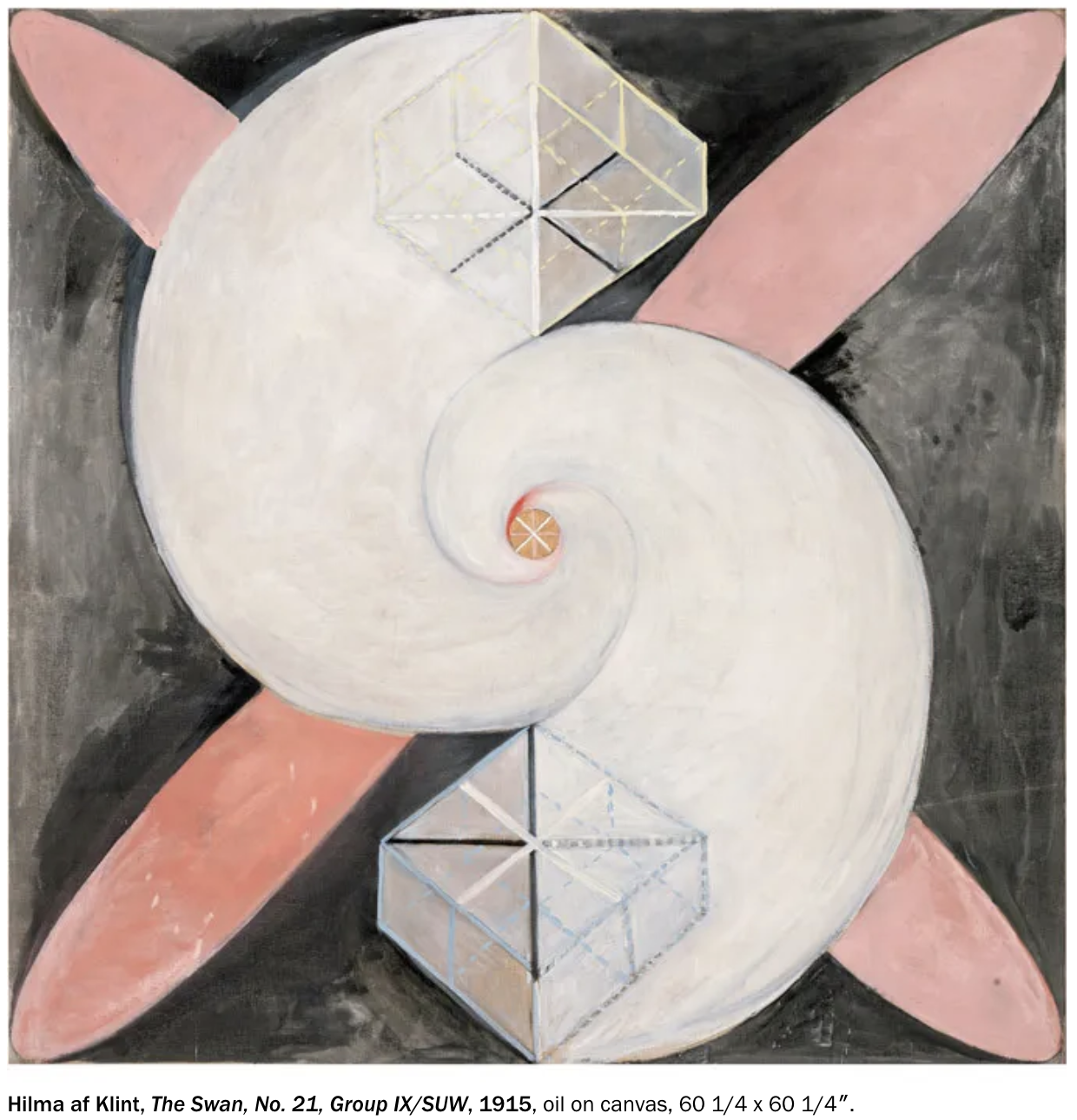
Swedish artist, Hilma af Klint, explored spirals in remarkably abstract, recursive, spatial and fractal ways often correctly mirroring and reflecting the mathematical patterns and consequential principals of design derived from the Golden Ratio. Her work predates the abstract movement and artist most commonly associated with it.
LET’S PLAY AGAIN!
PREDICT & ENVISION

GOLDEN SPIRALS
In mathematics, a spiral is a curve which emanates from a point, moving farther away as it revolves around the point.
PREDICT/Envision
The above design shows a white line running diagonally through the purple square…
What is the correct path for this line to continue along, in order to express an ever growing spiral?
Fibonacci Spirals are Golden Spirals

DOODLING IN MATH = LEARNING, BY DESIGN.
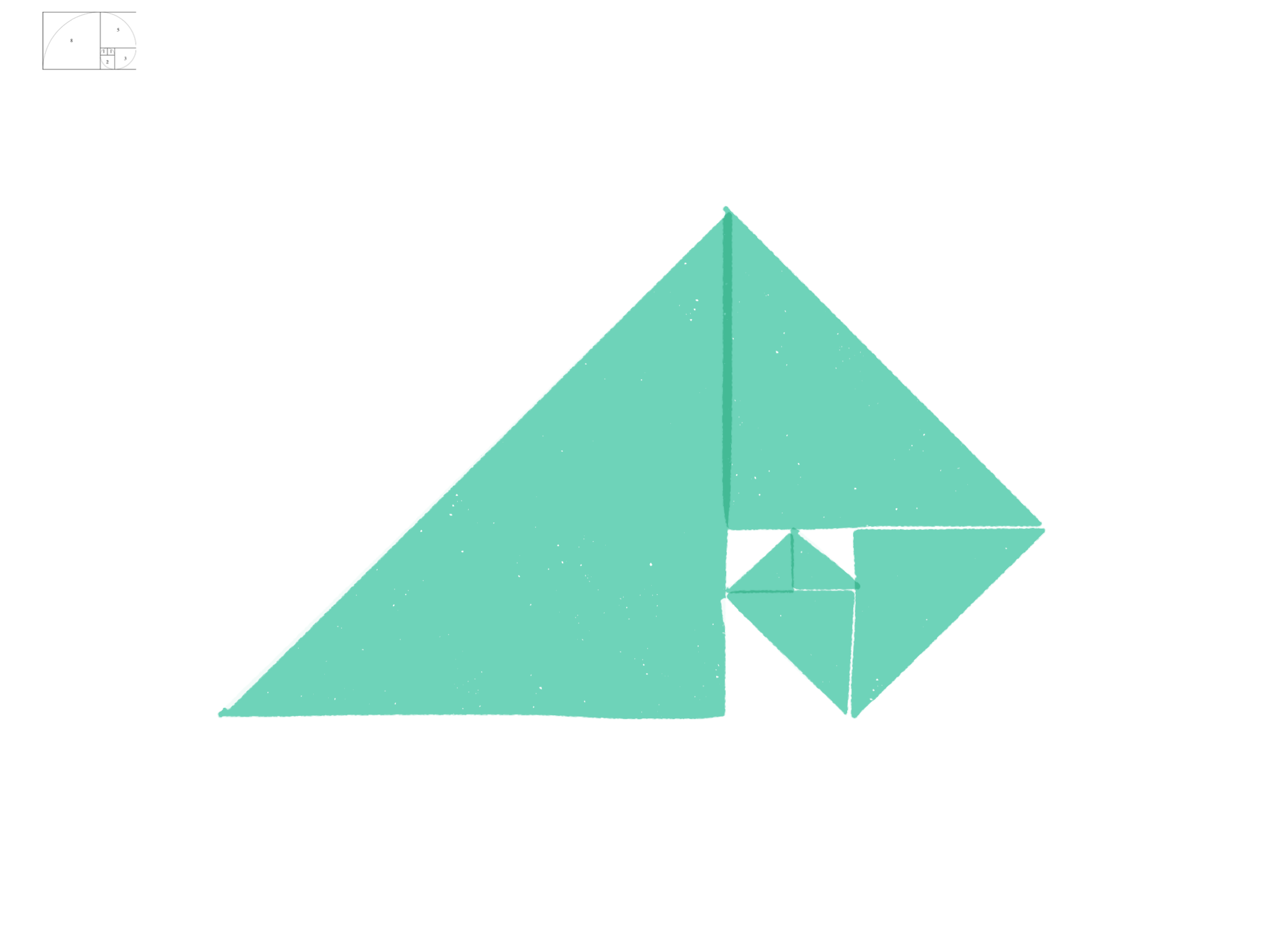
Golden Spirals, From triangles:
Construct
Create triangles from the squares by folding them diagonally - joining two opposite corners together.
Arrange
Arrange the triangles in the shape of a Golden spiral.
Create
Create a golden spiral
create another golden spiral. this time, out of negative space: Negative space is the empty or open space around and between the subjects of an image or design (see below).

Golden Spiral in positive space

Golden Spiral in negative space.

Fibonacci Snail, by Ottilie Allen, 3rd Grade.
SNAIL? WAVE? SHELL?
One more flick!
BLOOMS
Do spirals have a New Shape of Meaning for you?
Stay tuned!
Up next: Fibonacci Trees, Bees & Bunnies
Thanks for scrolling along with me.
Until next time….!


